General
Faraday vs Point‑Solutions: A comparison for handling stablecoin routing, compliance, and integrations
Faraday is the unified platform for stablecoin routing, risk, and intelligence. How does its operational simplicity compare to other solutions?

Syed C, Range
·
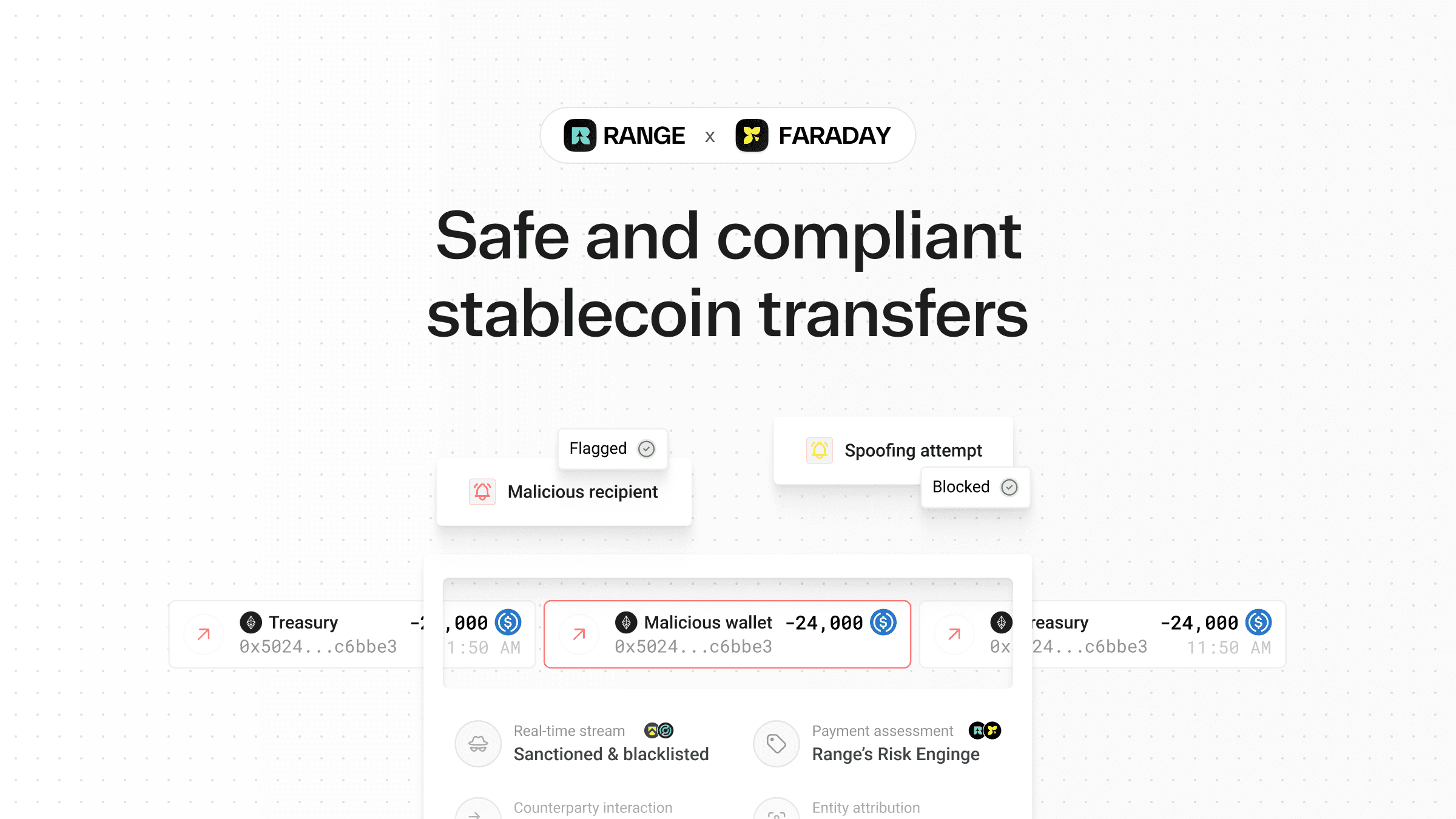
Faraday is Range’s new unified platform for stablecoin routing, risk, and intelligence. But how does it compare in practice to using standalone services for each part of the stack?
In this post, we break down how Faraday compares against a stitched-together architecture using tools like 0x or LI.FI for routing, TRM Labs or Chainalysis for risk, and Dune, The Graph, or custom in-house dashboards for analytics and compliance.
Architecture Overview
Most teams today rely on multiple vendors to enable stablecoin movement at scale:
Swap aggregator (e.g. 0x, 1inch, LI.FI)
Risk/compliance vendor (e.g. TRM Labs, Chainalysis, Elliptic)
Analytics or data layer (e.g. Dune, The Graph, internal indexing pipelines)
Custom logic to orchestrate routing, screen for sanctions, and assemble an audit trail
Faraday collapses these layers into a single API, with built-in routing, screening, transaction scoring, reporting, and data access.
By choosing Faraday, stablecoin issuers and integrators gain a platform specifically designed for their needs, reducing integration overhead while improving routing efficiency, compliance readiness, risk screening, and cross-chain support.
In the rest of this article, we will look at the operational implications and cost trade‑offs of using Faraday vs multi-vendor solutions across four key dimensions: routing/execution, risk/compliance, data/analytics, and integration overhead.
Case Study: AcmePay - A fintech simplifying cross-border remittances with Faraday
To understand how Faraday simplifies stablecoin infrastructure, before we get into the details of how Faraday simplifies your stack, let’s look at a fictional company in the regulated fintech space.
AcmePay is a licensed fintech based in Austria, focused on cross-border remittances and euro-denominated prepaid debit cards. The company accepts USDC, USDT, and EURe deposits into its mobile app, offering users a fast and affordable alternative to traditional banking rails. Users can send funds to family abroad, convert to local currency, or spend via AcmePay-issued debit cards.
As a regulated entity in the EU, AcmePay must comply with:
OFAC sanctions
EU financial sanctions and anti-terror financing lists
Austria’s FMA requirements, including local blacklist checks and auditability
AcmePay’s initial architecture relied on:
0x and LI.FI for cross-chain swaps and stablecoin routing
TRM Labs for wallet screening and sanctions compliance
In-house tooling for transaction logging, reporting, and audit trails
Manual reconciliation workflows for flagged transactions and escalations
This setup created several pain points:
Regulatory friction: Sanctions checks were not embedded in the execution path, introducing compliance gaps
Fragmented visibility: Data was split across vendors, with no unified record of each transaction’s route, risk status, or counterparty history
High operational cost: Coordinating updates across multiple SDKs and APIs increased dev and compliance overhead
Limited chain support: Bridging into Cosmos- or Solana-based stablecoins required additional tooling and effort
After integrating Faraday, AcmePay was able to:
Use a single API for routing, risk, and compliance across Ethereum, Solana, Arbitrum, and Cosmos
Perform real-time OFAC, EU, and Austrian blacklist checks on each transaction before execution
Generate audit-ready records for all stablecoin deposits and remittances
Reduce time-to-settlement and compliance turnaround while improving user experience
Decrease engineering maintenance load by 2 FTE, since chain or vendor-specific quirks were eliminated
The result: faster onboarding for new regions, instant expansion of cross-chain deposits, simplified backend infrastructure, and reduced regulatory risk - all without sacrificing control over execution or custody.
Dimension | Multi-Vendor Stack | Faraday |
Routing & Execution | Manual orchestration via 0x, 1inch, LI.FI | Unified API with multi-chain aggregator logic |
Risk & Compliance | Multiple API calls to TRM, Chainalysis, or Elliptic, each with unique outputs | Embedded screening, real-time address + tx scoring |
Data & Reporting | Separate dashboards: Dune, The Graph, in-house logs | Unified observability + audit trail via Range backend |
Integration Overhead | 3+ integrations, bespoke logic, per-chain support | One integration; unified flows across tokens/chains |
Chains Supported | Often fragmented (EVM only, or Non-EVM partial) | EVM + Solana + Stellar + Polkadot support built-in |
With rising adoption of stablecoins, both for crypto-native applications and traditional use cases migrating onchain, fraud, scams, and counterparty risk are increasing. At the same time, regulatory expectations are rising – from FATF guidance and Travel Rule requirements to OFAC-aligned sanctions screening and jurisdiction-specific blacklists.
As stablecoin adoption accelerates, onchain businesses need infrastructure that can handle this scale and complexity reliably. Yet most teams still rely on fragmented systems: one tool for routing and swaps, another for compliance checks, another for risk assessments, and separate systems for reporting and audit trails. This fragmentation leads to inefficiencies, higher operational cost, and gaps in oversight.
Faraday from Range brings all these capabilities together in a unified API for stablecoins: routing and execution, risk screening, compliance, reporting, historical and real-time intelligence. Because Range already powers security and intelligence for many of the largest chains and ecosystems, Faraday builds on that strength to deliver enterprise‑grade infrastructure for stablecoin flows.
Detailed analysis of Faraday
Let’s dive into how Faraday can help you.
1. Routing & Execution
Multi-Vendor Stack: You build custom orchestration logic to query quotes, fallback between aggregators who have unique API outputs, and manually handle bridging and orchestrate token flows. You’ll need to maintain logic for token/chain pairs, network fees, aggregator fee optimization, fallback routes, and signing strategies.
Faraday: Single API returns best path (including bridging) across supported chains and stablecoins, with real-time updates to liquidity sources. Faraday supports same-chain, cross-chain, and multi-hop stablecoin swaps with price/time efficiency built in - and supports both signed and unsigned flow variants for different execution models.
Under the hood, Faraday integrates with a range of swap aggregators to give you the best route, always. For single‑chain, single‑token transfers, Faraday bypasses external aggregators and returns an unsigned transaction. For single‑ or cross‑chain swaps, Faraday sources the best available prices from integrated aggregators/liquidity venues, returns one or more unsigned quotes for review, then you sign and submit.
Technical advantage: By centralizing routing logic, Faraday reduces integration complexity and the risk of edge cases (token pairs unsupported, routing loops, and fallback failures). We also instantly expand your cross-chain routing capabilities - beyond what any single aggregator or bridge could offer.
2. Risk & Compliance
Multi-Vendor Stack: You’d integrate a separate vendor (or internal module) for sanction lists, wallet‑behaviour analytics, address poisoning detection, Travel Rule compliance, reporting and logging. These often come via heterogeneous APIs requiring custom orchestration and introduce sync delays: quote → risk screen → sign → submit → log.
Faraday: It provides built‑in risk management at the quote and submission stages. Risk screening is part of the quoting and submission flows. You get:
The most comprehensive cross-chain flow-of-funds tracking
AI-enhanced address reputation and behavioral labels
Risk score per transaction, counterparty and even the swap venue
Full transaction simulation for EVM and SVM transactions
Pre-execution report to your app, so that you can alert your user or block the transaction
Our real-time risk screening helps ensure compliance with regional regulations, as well as Travel Rule compliance, and supports audit-ready metadata output for your records.
Technical advantage: The risk screening is embedded directly into the same API call used for quoting and submission. This reduces latency, coordination overhead, and the risk of misalignment between routing and screening. Moreover,
3. Data, Analytics & Historical Reporting
Multi-Vendor Stack: You’ll collect logs from aggregator(s), risk vendor(s), compliance modules, build your own data warehouse, dashboards and audit‑trail. Integration and data‑schema mismatch are common issues, not just among vendors, but also onchain data across chains.
Faraday: Every transaction quote, submission, and screening event is logged and queryable. This creates:
Full audit trail
Compliance-ready records
Time-series and counterparty summaries
Single API to query all onchain data of your customers’ wallets
Faraday provides a consistent schema across chains and tokens, abstracting chain-specific quirks (e.g. Solana vs EVM block models). As a result, you have a unified API endpoint regardless of the underlying chain or token flows.
Technical advantage: Single source of truth for all your routing, risk management, compliance and transaction metadata with a simplified, ready-to-ingest data architecture. Audit‑trail is consistent across all parts of your payment flow.
4. Integration Overhead & Maintenance
Multi-Vendor Stack: Each vendor and chain integration requires its own SDK/API, versioning, monitoring, error‑handling, and upgrade cycles. You’ll need to manage chain-specific quirks (EVM vs. Solana vs. Stellar) across various tools. Additionally, if you change an aggregator or risk vendor, you must adjust your routing logic and data flows accordingly.
Faraday: One integration. One monitoring pipeline. One API version. All chains are handled natively by Faraday’s backend. Updates to routing logic or risk scoring are automatically reflected in your integration - no rework needed.
As of right now, Faraday supports stablecoins on Arbitrum, Avalanche, Base, Binance Smart Chain, Celestia, Ethereum, Neutron, Osmosis, Polygon and Solana, with cross-chain routing aggregated from Skip GO, Squid, deBridge, Relay, Switchain and LiFi. More chains and aggregators will be added in the coming weeks.
Technical advantage: One API, one integration point, and one logic layer simplify onboarding, monitoring, upgrades, and auditing, reducing vendor lock-in and disparity across chains.
Faraday - the transaction engine for safe, scalable and compliant stablecoin payments
Faraday is most effective when your app:
You are moving stablecoins at scale across chains and tokens, and you need best execution plus institutional‑grade risk/compliance.
You want to reduce the operational burden of managing multiple vendors or integrations.
You require auditability, reporting, and transparency and want to avoid “tool‑sprawl”.
You are building protocols, wallets, fintechs, custodians or payment platforms where stablecoin flows are embedded into your business logic.
If you are only executing simple same‑chain swaps, or you already have a fully custom routing and risk stack, you might partially benefit - but even then, you may delegate non‑core infrastructure to Faraday and focus internal effort where you add differentiation.
If you’re currently managing 2-3 vendors to support stablecoin flows, Faraday will instantly simplify your stack and strengthen your architecture.
If your business deals with stablecoins - whether payments, treasury, wallet, exchange or protocol - Faraday offers a secure, scalable and efficient infrastructure layer built for modern multi‑chain operations.
Explore our Faraday API guide or book a demo with our team to see what’s possible with Faraday.